
Please see relevant disclosures here.
A neocloud can have customers, signed contracts and GPUs available for purchase, yet still struggle to borrow. Creditors need to establish who will pay, what must happen before payment becomes due, and how much debt those payments can retire. If repayment also requires future customers, they must underwrite the fleet’s earning power after its existing contracts expire.
These are different credit problems. A stronger customer or guarantee can make a contractual payment more dependable. A compute derivative can transfer a specified rental price exposure. Forward curves and residual value curves can help lenders assess both operating earnings and recovery, but information becomes credit protection only when a contract, hedge or other funded arrangement makes it actionable.
The distinction explains how substantial GPU financings can coexist with financing difficulties elsewhere in the neocloud market.
Lambda’s $926 million facility, closed this past August, finances infrastructure for an investment-grade customer. It received a Baa2 rating and priced at SOFR plus 300 basis points. The loan fully amortizes by December 2030 on a schedule aligned with contracted cash flows and the equipment’s useful life. The structure gives creditors a defined customer obligation and a repayment schedule designed around it.
CoreWeave’s $2.6 billion DDTL 5.5 has a somewhat different structure. It accepts more exposure to what follows the initial contracts. Its approximately five year maturity extends beyond customer agreements averaging three years. But the SEC filing also discloses an unconditional parent guarantee and a minimum debt service cover ratio of 1.35 times once testing begins. Lenders have accepted renewal risk within that package. The transaction does not isolate their willingness to finance the equipment’s future rental income without parent support.
For smaller operators, the obstacle can arise before the first deployment. Business Insider reported that GMI Cloud faced financing difficulties associated with banks’ treatment of frontier AI customers as non-investment grade. GMI adopted an arrangement under which Nvidia provides support if a customer stops paying, in exchange for revenue sharing. Nvidia’s July announcement of its financing model acknowledges that even long-term commitments could be insufficient to unlock financing for emerging AI businesses. Credit support addresses the quality of the payment obligation behind the demand.
Credit weakness can also prevent a neocloud from obtaining premises. In April, Data Center Knowledge described an unnamed operator’s unsuccessful attempt to secure an initial 2MW deployment, expanding to 12MW. It offered a 15-year term, six months’ prepayment and millions toward cooling infrastructure. This was a rejected colocation transaction, rather than a failed GPU loan. Its financing mechanism is nevertheless revealing: Core Scientific’s COO explained that weaker tenant credit reduces the debt developers can raise against project cost, increasing their required equity. A neocloud can offer an attractive rent and still be an unattractive tenant if its covenant makes the building harder to finance.
These examples suggest three distinct underwriting cases:
A single borrower can contain all three. Its financings should reflect which revenues support each loan.
Across these cases, lenders need operational evidence as well as contractual protection. A signed agreement requires scrutiny of acceptance conditions, termination rights, and service credits. Deployment requires power, cooling and a credible commissioning schedule. Equity and liquidity must cover delays and overruns. Security over equipment requires identifiable assets, clear priority and a practical way to preserve or realize their value.
Rapid obsolescence is manageable if the debt amortizes quickly enough. A GPU does not need a long economic life to support a sound loan; it needs to generate sufficient cash before its earning power deteriorates. Conversely, continued technical usefulness offers little comfort if the prices available for that usefulness cannot support the remaining debt and operating commitments.
The difficult exposure is the debt balance left when contractual protection falls away. At that point, a hardware transition can weaken rental prices, utilization and resale values together. If several fleets are marketed simultaneously, prospective buyers may also face tighter financing. A parent guarantee can lose value during the same downturn.
This correlation limits the protection supplied by an ordinary equipment appraisal. Creditors need recovery estimates conditional on distress: what the assets might fetch when the borrower fails, potentially alongside other operators. A central estimate of future resale value answers a different question.
Recovery also depends on how much of the operating business survives enforcement. A cluster earning revenue inside an effective cloud platform may be worth substantially more than its equipment sold separately. Access to premises, continued power and cooling, transferable operating arrangements and a funded transition to another operator therefore belong in the credit analysis. Improving those arrangements could expand lending without any change in GPU price expectations.
Forward curves and residual value curves would make this underwriting more consistent. Their first contribution is informational. A credible rental curve gives lenders a common basis for challenging renewal assumptions, comparing borrowers and setting repayment schedules. A residual value curve helps assess remaining collateral coverage. This can reduce the uncertainty and expense of underwriting before a deep derivatives market exists.
The distinction between a forecast and an executable price remains essential. A modeled rental curve describes an expectation. A traded forward curve reflects prices at which exposure can be transferred, including risk premia and liquidity conditions. A lender can use both, but only the latter can support an actual hedge, and only for the maturities and volumes available.
Residual estimates must reconcile with those rental economics. A future buyer pays for the earnings or alternative uses it expects to obtain. A model assuming sharply falling rental income needs an explanation for resilient resale value. Continued use in inference or other workloads may provide that explanation, but only after accounting for demand, conversion costs, downtime and competing uses of power. The existence of another use does not establish the price at which a retiring fleet can move into it.
The useful comparison puts debt outstanding, contracted cash available for debt service, prospective rental earnings and stressed recovery on the same timeline. It shows where protection weakens and whether repayment must accelerate. Earnings embedded in a terminal valuation must not also be counted separately as operating cash flows.
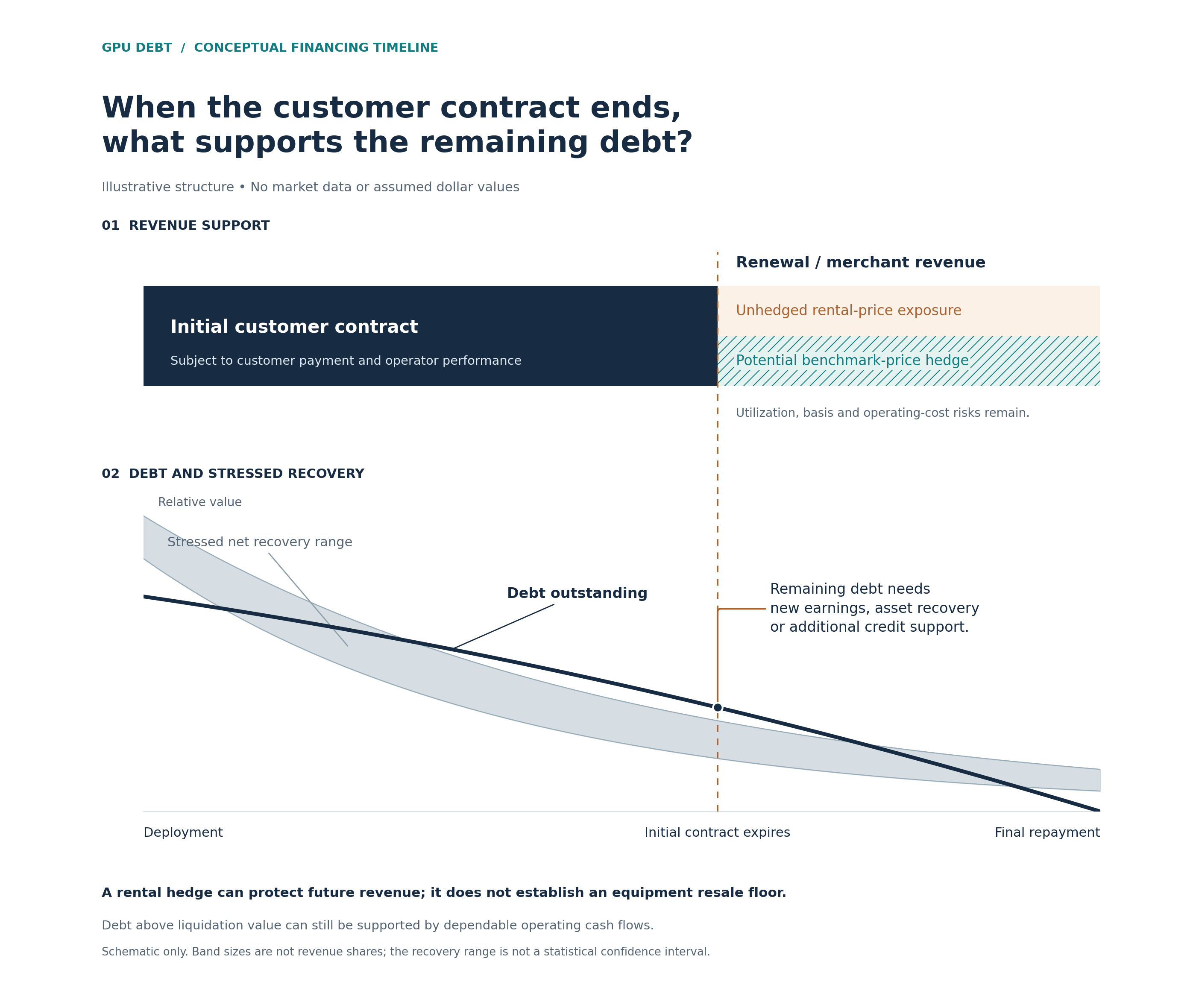
A compute hedge adds a second contribution: it can change the cash flows available to repay the loan.
For uncontracted capacity, rental revenue equals sold GPU hours multiplied by realized price. A producer selling a fixed price financial hedge receives a payment when the settlement index falls below the agreed price. If sold hours match hedged hours and realized prices track the index, the combination stabilizes rental revenue for those hours. Utilization, operating costs and customer payment remain separate exposures.
In August, CME announced proposed H100 and B200 rental index futures for an October 5 launch, pending regulatory review. Their financing value will depend on market depth, available maturities and the relationship between each borrower’s realized prices and the settlement index. Region, configuration and service terms can create basis risk. Rolling short-dated contracts does not lock in the prices available for future renewals.
The hedge also needs liquidity. Rising rental prices can produce immediate margin calls on a short futures position before higher customer receipts arrive. A lender recognizing the protection must account for the cost of funding those calls. Otherwise, the financing substitutes a near-term liquidity problem for part of its longer-term price risk.
Existing fixed-price customer contracts already provide price protection, conditional on payment and performance. Additional hedging should correspond to genuinely exposed capacity. Hedging replacement revenue after a possible customer default is harder because the timing and volume are uncertain.
This makes the relationship between derivatives and covenants a commercial question. Covenants constrain behavior and give lenders rights when performance deteriorates. Parent guarantees provide another source of recovery. A hedge supplies cash against a defined market movement. A lender with sufficient contractual protection and recourse may reasonably conclude that the hedge’s incremental benefit does not justify its cost.
The strongest prospective application is financing earnings after initial contracts expire. Senior debt could be sized against contracted cash flows, with further borrowing supported by conservatively hedged rental earnings. Equity or junior capital would absorb exposures that remain too uncertain for senior lenders.
The benefit could appear as additional debt, longer maturity, lower required equity or reduced parent support. Releasing a corporate guarantee could be particularly valuable to an operator seeking to finance another deployment. That outcome would require lenders to recognize the hedge’s protection after allowing for basis risk, utilization uncertainty, counterparty exposure and liquidity costs.
This is a testable financing proposition: does the hedge reduce stressed losses enough to change the terms of the loan? Better curves can make the answer easier to establish. Willing counterparties and durable hedge arrangements can make the protection available. Where customer credit or execution remains the binding constraint, rental price protection will have less effect; where lenders must rely on future market earnings, it could materially expand the amount of GPU revenue they are prepared to finance.
If you enjoy this newsletter, consider sharing it with a colleague.
I’m always happy to receive comments, questions, and pushback. If you want to connect with me directly, you can: