Can CoreWeave escape the landlord tax?
CoreWeave is signing impressive deals with hyperscalers; whether that revenue flows through to shareholders or landlords remains an open question
This past August, I wrote a fairly negative piece about CoreWeave. More recently, short seller Kerrisdale Capital released a jeremiad against the company. (I continue to hold no position in CoreWeave.) And, today CoreWeave announced a multibillion dollar partnership with Meta. Its stock popped.
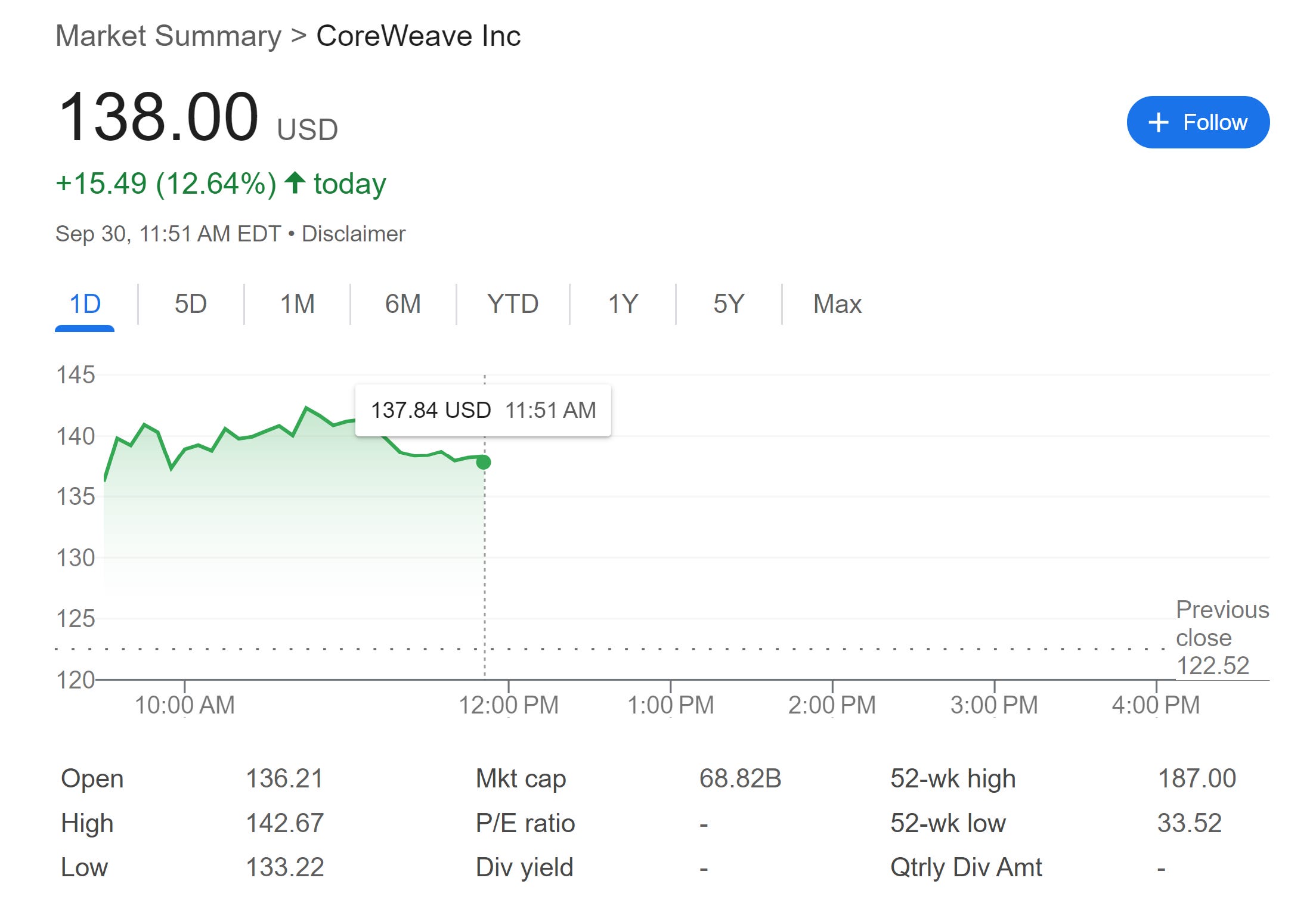
So what’s going on?
My main criticism about CoreWeave was that it is functionally an intermediary. It sells compute to hyperscalers and other companies. It rents from corporate landlords. Whatever margin it generates by selling compute to hyperscalers and other customers is eaten by its landlords’ annual rent escalators. That’s a tidy story, and it made sense in August. It makes a little less sense now, but, as always, there is nuance to be had.
At first glance, the Meta partnership is a watershed moment for CoreWeave. But, if CoreWeave doesn’t own most of its real estate, won’t landlords simply capture the upside? The answer is yes, in part. But the dynamics are more complicated, and CoreWeave is actively restructuring itself to avoid being a mere passthrough to landlords.
At the heart of the issue is margin capture. Data centers are built on layers: land and shells owned by real estate developers, power and cooling infrastructure, racks of GPUs, and the service layer that packages compute for clients like Meta and OpenAI. If the operator only leases the physical facility, much of the incremental value created by mult-billion-dollar contracts can be siphoned off by the landlord through escalating rents or renewal negotiations. This is why CoreWeave’s S-1 explicitly flagged lease dependence as a risk.
That said, CoreWeave is not standing still. The company has locked in very long leases with fixed or capped escalators. These deals provide predictability and blunt the ability of landlords to ratchet up costs in response to booming AI demand. Lease structures also vary: many are triple-net, meaning CoreWeave pays most operating costs directly. While that sounds burdensome, it actually limits the landlord’s ability to skim upside, since rent is tied to the shell rather than the full infrastructure stack.
More importantly, CoreWeave has begun a pivot to ownership. It has selectively purchased key sites, such as the NEST data center in New Jersey and a former Merck campus intended for redevelopment into a large compute hub. The pending $9 billion all-stock acquisition of Core Scientific is even more significant: by absorbing a major operator with 1.3 GW of gross capacity, CoreWeave expects to eliminate $10 billion in lease obligations and save half a billion annually by 2027. This represents a deliberate move to internalized what had previously been landlord profit.
Strategy partnerships further blunt the rent tax. In several cases, CoreWeave joint-ventured with developers or secured build-to-suit facilities where its bargaining leverage, rooted in enormous GPU demand, lets it lock in favorable terms. For landlords, losing CoreWeave as a tenant would mean losing one of the most power-dense and creditworthy tenants in the industry. That asymmetry gives CoreWeave room to negotiate.
It’s also worth noting that even with ownership, costs don’t disappear. Property taxes, depreciation, and obsolescnece all migrate onto CoreWeave’s balance sheet. Still, ownership turns those costs into investments rather than rents, creating the potential to capture residual value as data center assets appreciate in a constrainted market. In other words, CoreWeave would rather carry the burden of ownership than let landlords skim off the margin generated by contracts with Meta or OpenAI.
The upshot is that the real estate worry is real: landlords do capture a share of value in lease-heavy models, and it constrains operator margins. But CoreWeave appears acutely aware of this and is in the midst of a strategic transition. By combining long leases, selective ownership, and a transformative acquisition of Core Scientific, it is trying to flip the script. Whether it succeeds will define how much of the Meta deal’s $14.2 billion ultimately flows to shareholders rather than to the owners of data center shells.
If you enjoy this newsletter, consider sharing it with a colleague.
I’m always happy to receive comments, questions, and pushback. If you want to connect with me directly, you can:

