
Please see relevant disclosures here.
The AI infrastructure boom is usually described through model usage and revenue on one side, and hyperscaler capital spending and cloud backlog on the other. Both indicate demand. Neither explains how risk passes from the model user to the company building its capacity.
The contracts connecting those layers need not have the same duration. An enterprise can move among models, buy through a cloud marketplace or pay as it goes. A lab must secure capacity before demand arrives, creating hyperscaler backlog before it earns corresponding customer revenue.
Public disclosures make the upstream side visible. AWS has announced eight- and ten-year commitments with OpenAI and Anthropic; Microsoft has reported extraordinary OpenAI concentration in its backlog. Downstream, Microsoft says customers increasingly use multiple models. The question is whether that choice-preserving demand provides the same contractual coverage as the capacity secured to serve it.
The evidence is uneven. Filings describe hyperscaler contracts but reveal little about private labs’ customer agreements. Multi-model usage proves that customers value optionality, not that commitments are small. The largest disclosed obligations sit between labs and hyperscalers; comparable model-specific coverage downstream remains unknown.
What RPO tells us
To follow the risk, begin with the accounting measure often presented as evidence of future demand. Remaining performance obligations, or RPO, is revenue a seller expects from contractual obligations it has not yet satisfied. It generally includes deferred revenue and non-cancellable amounts to be invoiced later. It is neither recognized revenue nor guaranteed cash.
RPO excludes uncontracted activity. On demand usage, overages and renewals can produce real revenue without appearing in it. Booking is a variable defined sales measure; annualized run rate extrapolates a recent pace. Neither is GAAP revenue or RPO.
The distinction matters when RPO appears mid-supply-chain. The same contract is a cloud purchase obligation for a lab and RPO for the hyperscaler. That RPO can be valid without equivalent end customer commitments. The accounting establishes a contract; it does not identify who bears the utilization risk.
Why model choice matters
Once expected consumption is separated from contracted consumption, Microsoft’s multi-model disclosures take on a more precise meaning. The company said more than 1,500 customers had used both Anthropic and OpenAI models through Foundry. Three months later, it said a majority of GitHub Copilot users used multiple models.
Models have not become interchangeable utilities. APIs and routing reduce switching costs, but applications remain sensitive to capability, latency, tool use, prompt behavior, safety policies and data controls. Changing models still requires evaluation and governance.
Contractual portability is nevertheless increasing faster than operational fungibility. An enterprise may retain the right to redirect workloads even when swiching remains expensive. It can commit at the AWS or Azure level while allocating that budget among models and other services. Backlog then accrues to the platform, not necessarily one model provider.
A company can still commit substantial sums to two providers. Microsoft establishes option value, not the size of direct model commitments.
Snowflake as the public analogue
Frontier models do not publish information about their contracts, but Snowflake’s filings provide a public analogue. Customers choose between one-to-four year capacity contracts and on-demand arrangements, with revenue recognized as resources are consumed.
Snowflake reported $9.0 billion of RPO at July 31, with a 2.4-year weighted-average remaining life. It excludes on demand arrangements and consumption above capacity. Customers may roll unused capacity into a later order if they buy more at renewal. Usage can exceed RPO, while commitments may convert slowly.
Snowflake also demonstrates that sophisticated buyers make large AI commitments. Its unnamed AI provider agreement carries a $390 million minimum through November 2028, with $270 million remaining. Annual shortfalls are payable, but certain public cloud services count toward the minimum, preserving some channel flexibility.
The filing also disclosed a $6 billion, five year cloud infrastructure commitment. Snowflake thus occupies both sides: a consumption vendor facing variable usage and a capacity buyer making larger upstream obligations.
The structure at hyperscaler scale
Snowflake shows the structure inside one company. Amazon and Microsoft show its scale. Amazon’s long-term performance obligations, primarily AWS, rose from $244 billion with a 4.1 year weighted average life at December 31, 2025 to $496 billion and 6.4 years at June 30, 2026. AWS also added $100 billion over eight years to an existing $38 billion OpenAI commitment and expanded Anthropic’s commitment by more than $100 billion over ten years.
Amazon does not reconcile the increase by customer, so those agreements are not a complete bridge between balances. They still show individual AI counterparties entering obligations large enough and long enough to affect hyperscaler backlog.
Microsoft reported $678 billion of commercial RPO with a 2.3 year weighted average duration at June 30. Six months earlier, OpenAI represented approximately 45% of its $625 billion commercial RPO, while large OpenAI and Anthropic commitments helped drive a 230% increase in bookings. The 45% figure cannot be applied to the later balance, but it reveals extraordinary concentration at that point.
Placed in sequence, the contractual roles look like this:
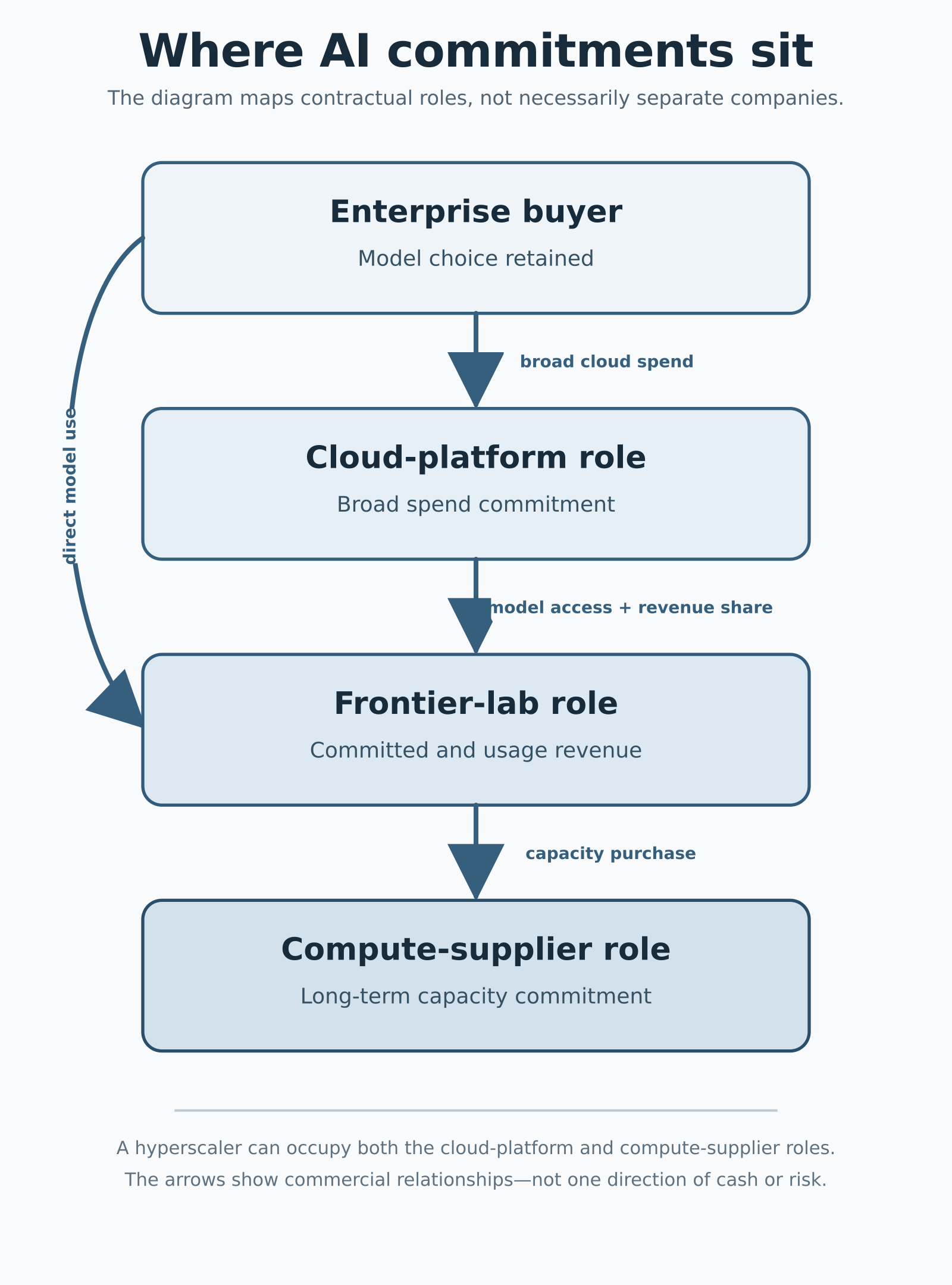
The enterprise can buy through a cloud commitment or directly from a lab. The platform distributes model access; the lab purchases capacity. A hyperscaler can occupy both platform and supplier roles, while strategic investment adds another relationship. The arrows show relationships, not one direction of cash or risk.
Where the mismatch becomes financial
Separating the roles matters because each arrow changes the obligation. A lab can commit to multi-year compute while efficiency improves, prices fall and workloads shift. Usage can grow while revenue per unit of reserved capacity declines. Unless the supplier agreement adjusts, the lab retains the difference between a firm obligation and variable downstream yield.
Where that risk ends up depends on nonpublic minimums, price resets, eligible chips and regions, remedies, transfer rights and permitted workloads. The hyperscalers may share the exposure, and renegotiation may mitigate it. RPO alone cannot answer the question.
Financing adds another layer. Amazon both invests in and supplies compute to Anthropic and OpenAI. Microsoft’s fiscal 2026 10K identifies OpenAI as a related party, reports $24.1 billion of revenue from OpenAI commercial arrangements and a $6.0 billion year-end receivable. Microsoft also reported an approximately 25% interest and $11.9 billion funded against a $13 billion investment commitment.
These relationships do not make the revenue artificial. But RPO supported by operating cash is not economically identical to RPO supported by a lab that must keep raising money. Cloud revenue can be contractually real while its credit quality depends on continued customer financing. The question is whose balance sheet supports the obligation.
What Anthropic’s S-1 must reveal
That is why Anthropic’s eventual public filing matters. The company confidentially submitted a draft S-1 on June 1, but it has yet to be made public. Counterparty filings reveal upstream arrangements, but not whether Anthropic has matched them with direct RPO, marketplace usage, protections or financing.
The first disclosure to examine should be a year-by-year comparison of downstream contracted revenue and upstream compute minimums. Investors will also need channel concentration, revenue sharing, gross margins, termination rights, receivables and the cash required to bridge supplier payments to customer collections. Until then, Anthropic’s contractual coverage remains an inference.
What a slower frontier would change
The mismatch also clarifies the economics of slower model development. If rapid turnover makes customers reluctant to commit, a slower cadence could lengthen models’ commercial lives and make longer contracts easier to sign. Fewer frontier training runs could reduce future capacity requirements.
That would not solve utilization automatically. Customers might delay deployments, open-weight models could improve and existing commitments would remain. Lower training demand helps only if qualifying workloads absorb the capacity. A slower frontier could reduce obsolescence risk while increasing utilization risk.
These are economic effects, not evidence of motive. Safety arguments can be sincere while benefiting incumbents. Nothing public establishes that calls to slow development are intended to conceal weak revenue.
The missing disclosure is the point
Across the chain, the record supports neither “AI demand is weak” nor “AI backlog proves final demand.” Customers value model choice; hyperscalers hold enormous, long-dated obligations from AI counterparties. The missing figure is how much independent, model-specific commitment supports them.
That omission neither makes revenue unreal nor proves that labs are undercontracted. It identifies what investors should measure: any gap between variable downstream economics and long-dated upstream obligations.
The eventual public filings should make that gap visible. Until then, the right conclusion is not that RPO has migrated upstream, but that contractual certainty is most visible, and demonstrably most concentrated, there.
If you enjoy this newsletter, consider sharing it with a colleague.
I’m always happy to receive comments, questions, and pushback. If you want to connect with me directly, you can: